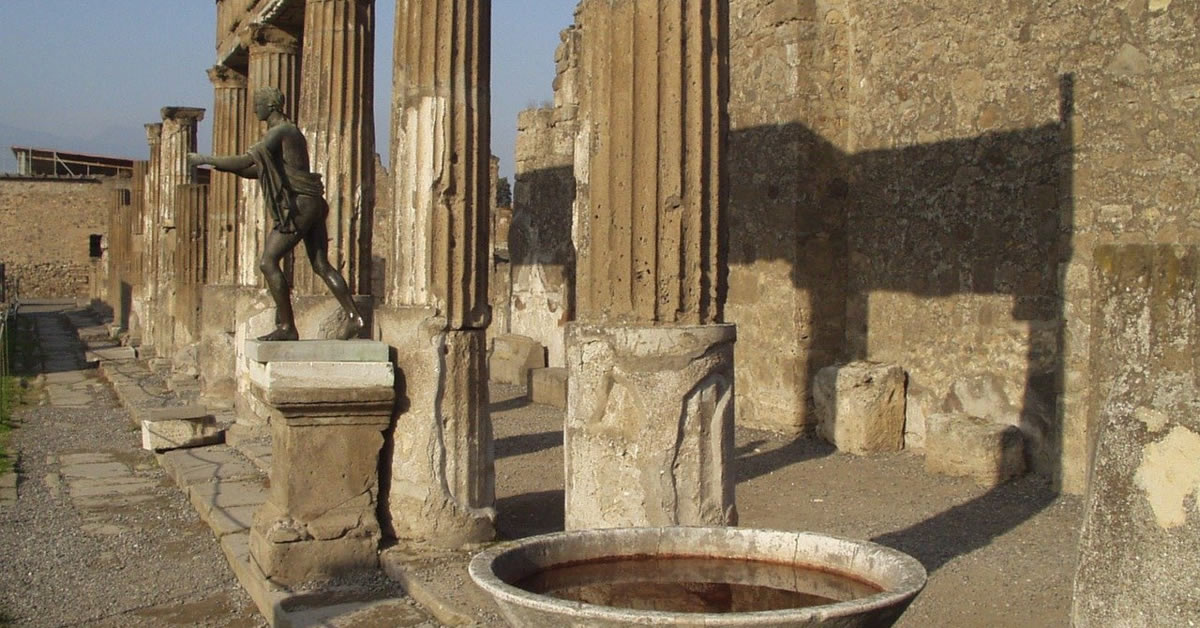
Declared a World Heritage Site by UNESCO, the excavations of Pompeii, Herculaneum and Oplonti represent one of the most famous tourist attractions in the world. Visiting these archaeological sites is a once in a lifetime experience.
It’s on everyone’s bucket list: visiting Pompeii, the ancient Roman city in was destroyed by a volcano and it’s still here to tell that story in every detail. Pompeii, along with Herculaneum and many villas in the surrounding area (Boscoreale, Stabiae), was buried under 4 to 6 m (13 to 20 ft) of volcanic ash and pumice in the eruption of Mount Vesuvius in AD 79. Largely preserved under the ash, the excavated city offered a unique snapshot of Roman life, frozen at the moment it was buried: visiting the archaeological site you will see human forms catched in the final moment of their lives. Giuseppe Fiorelli, one of the archaeologists who took charge of the excavations in 1863, realized that the spaces left by the decomposed bodies under the ashes could be injected with plaster to recreate the forms of Vesuvius’s victims. There are three entrances to Pompeii:
- At the Porta Marina entrance (closest to the Pompei Scavi – Villa Dei Misteri train station) where is a ticket office, toilets and left luggage lockers.
- At Piazza Esedra, a little further along from Porta Marina from the station, you’ll find a bookshop and toilets. There’s small police station just outside the Piazza Esedra entrance.
- At the Porta Anfiteatro entrance (closest to the modern town of Pompei) there is an ATM, bookshop, toilets and left luggage facilities.
You can book a guided tour in advance or find a local guide on the place. In alternative, you can download some app which provide all the info about this iconic place.
Like Pompei, Herculaneum is famous as one of the few ancient cities to be preserved more or less intact as the ash that blanketed the town also protected it against looting and the elements. Although less well known today than Pompeii, it was the first, and for a long time the only, buried Vesuvian city to be found (in 1709), while Pompeii was only revealed from 1748. Unlike Pompeii, the mainly pyroclastic material that covered Herculaneum carbonized and preserved more wood in objects such as roofs, beds, and doors, as well as other organic-based materials such as food and papyrus. Don’t miss this stop in your tour!
In the town of Torre Annunziata there is Oplonti, where two Roman villas were excavated, the best-known of which is the so-called Villa Poppaea. You shouldn’t miss this spectacular archaeological site either!