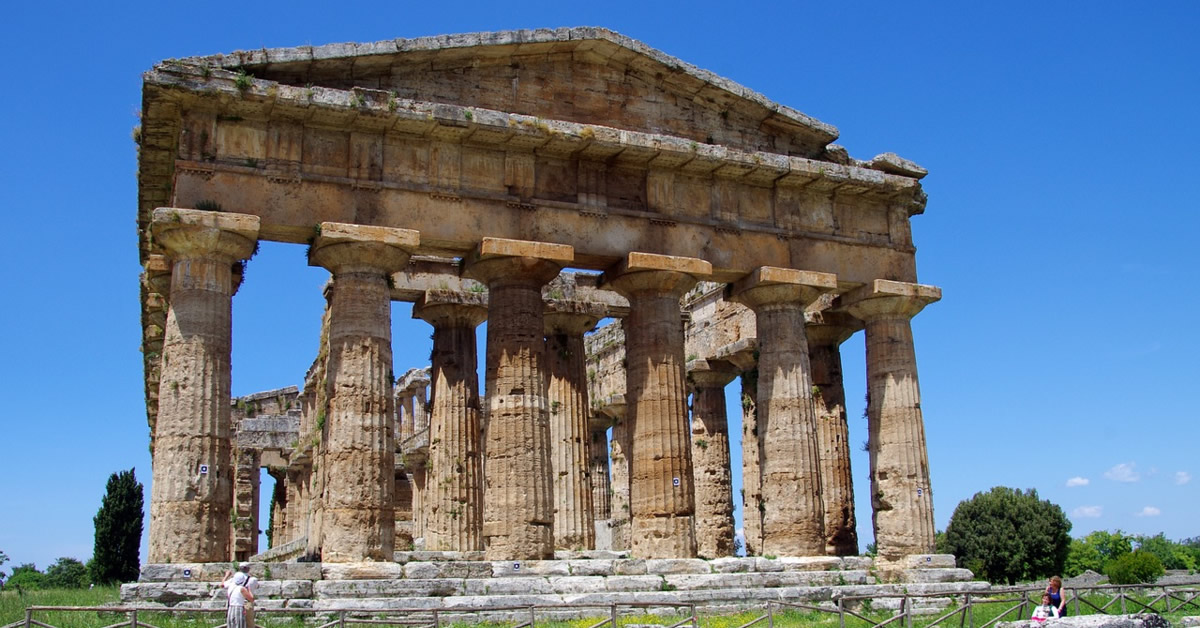
The temples of the Archaeological Park of Paestum are a unique testimony of Magna Graecia architecture, majestic and recently restored to give visitors the thrill of being face to face with history.
Paestum, with its iconic temples, is an unmissable stop in the province of Salerno, located as a fraction of the municipality of Capaccio-Paestum. Inhabited since prehistoric times, this area had its period of maximum splendour and wealth as a Magna Graecia colony, from 560 BC. to 440 BC approximately, with the Greek name of Poseidonia (it was named in honour of the god of the sea, Poseidon). The so-called Basilica, the so-called “Temple of Ceres” and the so-called “Temple of Neptune” date back to this period. Why do we write “so-called” in front of the name of these three imposing buildings? Because the attribution of each temple to a deity is in some cases controversial and in other cases the name that made the temple famous was assigned by the first archaeologists … in the wrong way! The Basilica is probably a temple dedicated to the goddess Hera – wife of Zeus and ruler of Olympus, the “Temple of Ceres” is actually probably dedicated to Athena – goddess of war, while the largest of the three, the ” Temple of Neptune “, for contemporary scholars it still has an uncertain attribution: it could also be dedicated to Hera, or to Zeus or Apollo.
Having become “Paistom” under the Lucanians, the city took the name of Paestum with the Roman domination. Its period of splendour continues even under the new dominations, and the “Greek character” will never be lost in the whole. The history of Paestum will continue through ups and downs until the seventh century, when it will be definitively abandoned by its inhabitants due to the swamping of the city: its location – incredible as it may seem – will be forgotten for a long time, its existence will be mentioned almost only by poets, until the beginning of 1700, when in some descriptive texts of the Kingdom of Naples there are some references to three “theatres” or “amphitheatres” near the Sele river. Around the middle of the seventeenth century, Charles of Bourbon had a road built in that area – the current SS18 – which, crossing the city, cut the amphitheatre into two parts … causing the definitive rediscovery of the ancient city. In that period the first reliefs, engravings and prints depicting the temples, drawings and sketches of admired visitors flourished: all this will make the rediscovery of Paestum an obligatory stop on the Grand Tour – the long journey in continental Europe undertaken by the rich of the European aristocracy from the eighteenth century, destined to perfect their knowledge, which has always included Italy.